



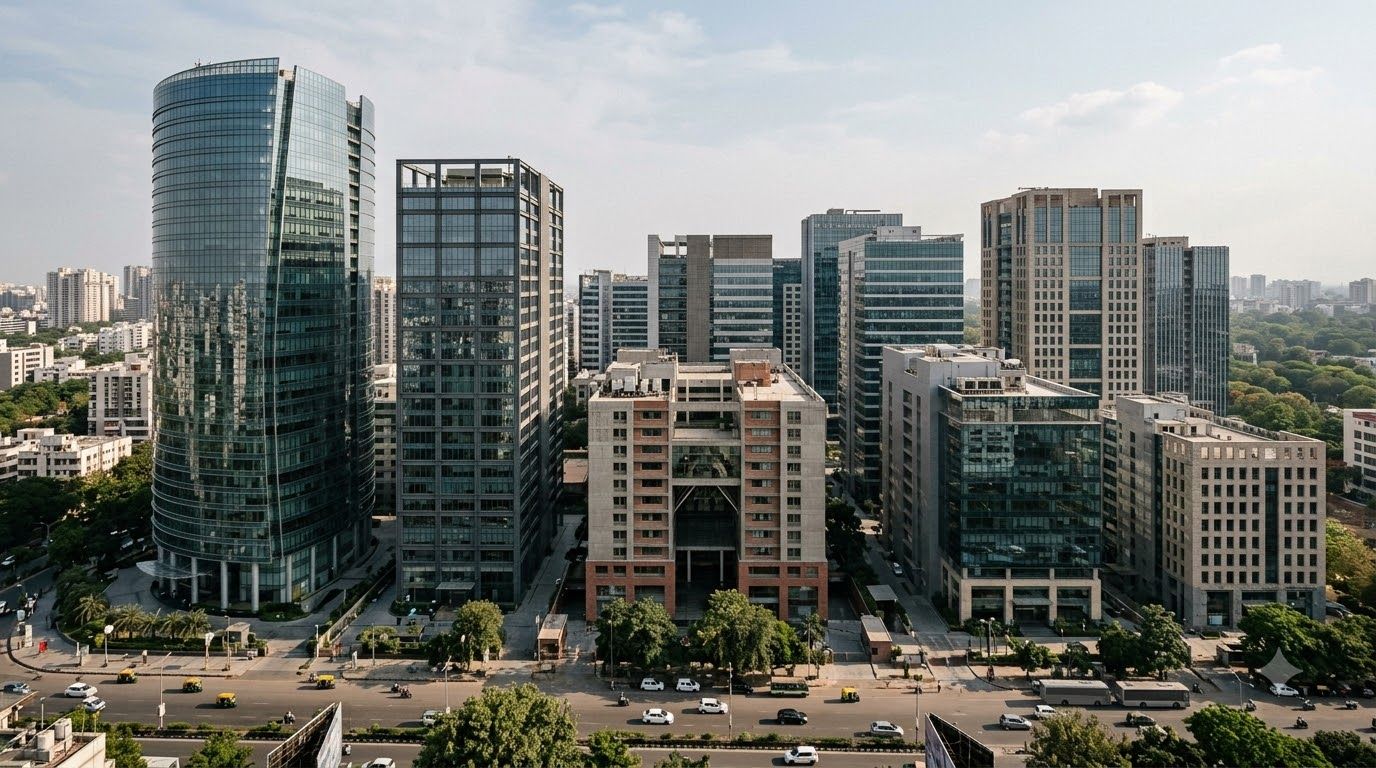

















































































For most of the past three decades, investing in Indian commercial real estate meant one thing: writing a cheque large enough to buy a floor, a shop or a warehouse outright, then becoming a landlord.
That is no longer the only option, and for a substantial share of capital it is no longer the sensible one. Between SEBI’s REIT Regulations in 2014 and the Small and Medium REIT framework notified in March 2024, India built a regulated architecture for owning income-producing commercial assets without holding the title deed.
Quick Answer
There are four ways to invest in commercial property in India: buying an asset directly, buying units in a listed REIT, investing in an SM REIT scheme from ₹10 lakh, or committing to a real estate fund. They differ mainly in capital required, liquidity and control — not in the underlying economics of rent and appreciation.
Why Commercial Property Attracts Institutional Capital
Commercial rental yields in India generally run 6% to 9% gross. Residential yields sit at 2% to 4%. That gap has persisted for years, and it is structural rather than cyclical.
Three features explain it. Commercial leases typically run five to fifteen years against eleven months for residential. They usually carry contractual escalation clauses, so rent rises without renegotiation. And the tenant is a company with audited financials rather than an individual.
The demand picture is currently strong. According to JLL, India’s office market recorded gross leasing of 83.3 million sq ft in 2025 and net absorption of 57.0 million sq ft — the highest on record. Vacancy fell to 15.2% by the fourth quarter and eased further to 14.7% in the first quarter of 2026. CBRE, using a slightly different methodology, put 2025 leasing at 82.6 million sq ft alongside record supply of 58.9 million sq ft.
CBRE expects global capability centres to drive roughly 35% to 40% of office absorption during 2026. That concentration is the market’s engine and its principal exposure in the same breath.
The Four Routes
Direct purchase
You hold the title. You choose the tenant, negotiate the lease, decide when to refurbish and when to sell. You also carry vacancy, maintenance, statutory compliance, property tax and the months it takes to find a buyer.
Grade A commercial assets in major cities typically start around ₹1 crore and rise steeply. Strata office units — individual floors or suites within a larger building — come cheaper but trade in a thinner market with weaker exit options.
Listed REITs
A REIT is a SEBI-regulated trust holding a portfolio of income-generating commercial property. It must invest at least 80% of asset value in completed, rent-generating assets, distribute at least 90% of net distributable cash flows, and cap leverage at 49%.
Listing is mandatory, and the minimum market lot has been reduced to one unit. You get diversification and daily liquidity. You do not choose the assets, and the unit price moves with interest rate expectations as well as rent collection.
SM REITs
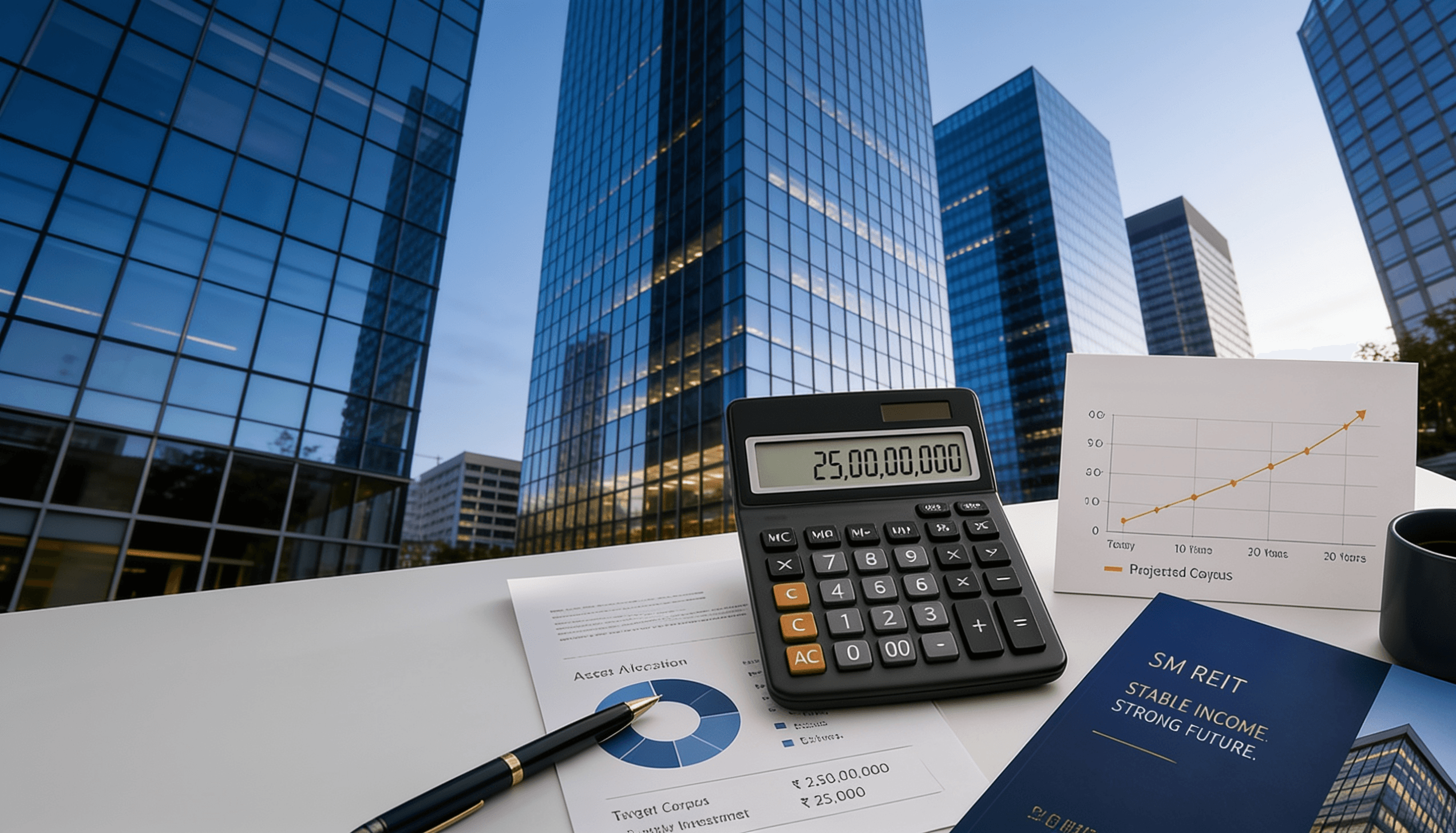
SEBI’s Small and Medium REIT framework covers schemes holding assets between ₹50 crore and ₹500 crore. The rules are tighter than for REITs: at least 95% of scheme asset value must sit in completed, revenue-generating property, under-construction exposure is not permitted, and the scheme must distribute 100% of net distributable cash flows quarterly.
Minimum investment is ₹10 lakh per unit. Listing is mandatory. The distinguishing feature is specificity — you can examine the building, the tenant and the lease before committing.
Real estate funds
Category II AIFs and similar vehicles offer professionally managed exposure, often including development or value-add strategies with correspondingly different risk. Minimum commitments typically start at ₹1 crore, with long lock-ins.
| Direct purchase | Listed REIT | SM REIT | Real estate fund | |
|---|---|---|---|---|
| Typical entry | ₹1 crore+ | Price of one unit | ₹10 lakh | ₹1 crore |
| Liquidity | Low — months | High — daily | Moderate | Low — locked |
| Asset selection | Complete control | None | Disclosed pre-investment | None |
| Operational burden | Full | None | None | None |
What the Lease Actually Says
Three clauses determine whether a commercial asset produces reliable income.
The lock-in period fixes how long the tenant must stay. A long lock-in with a creditworthy tenant is the closest thing to contracted income in property.
The escalation clause sets how rent grows — typically a fixed percentage at defined intervals. A fifteen-year lease without escalation locks you into today’s rent while your costs rise.
Weighted average lease expiry, or WALE, measures the average remaining lease term across a portfolio, weighted by rental contribution. Two assets with identical occupancy can have completely different income visibility. Occupancy tells you the space is let; WALE tells you for how long.
Read the lease itself rather than a broker’s summary. Escalation frequency, lock-in symmetry and exit clauses vary considerably, and the differences compound over a decade.
Due Diligence Before You Commit
For a direct purchase, ten checks are non-negotiable: the title chain traced back through the mother deed; an encumbrance certificate confirming no undisclosed charges; occupancy and completion certificates; a sanctioned plan matching what was built; fire, lift and power sanction NOCs; property tax receipts, paid and current; the full lease agreement rather than a summary; tenant financials; the common area maintenance structure and who bears it; and for strata assets, association by-laws and parking rights.
For the regulated routes, this work has been done and disclosed. The equivalent discipline is reading the scheme documents — asset details, tenant profile, lease terms and distribution history — rather than the marketing material.
The Costs Most Buyers Underestimate
The gap between gross and net yield is where first-time commercial investors are most often caught out. Two to three percentage points typically disappear between the headline figure and what reaches the bank account.
Stamp duty and registration vary by state and represent a meaningful percentage of transaction value. TDS of 1% applies on property purchases above ₹50 lakh. GST applies to commercial rent, and purchase of under-construction commercial property may attract GST where completed property does not.
Financing works differently from a home loan. Commercial property loans carry higher interest rates, loan-to-value ratios generally in the 55% to 70% range, and shorter tenures. Lenders underwrite on rental cash flow as well as borrower income, so a signed lease strengthens an application considerably.
Then the ongoing items: common area maintenance, property tax, insurance, brokerage on re-letting. And vacancy — the cost nobody budgets. A six-month void removes half a year’s income and often triggers fit-out expenditure.
Choosing Your Route
Four questions narrow the field quickly.
How much capital is genuinely available for an illiquid allocation? Below ₹10 lakh, listed REITs are the practical route. Between ₹10 lakh and roughly ₹1 crore, SM REIT schemes open up. Above that, direct purchase becomes feasible — which is not the same as advisable.
Do you want to run a property? Direct ownership is an operating commitment. The regulated pooled routes exist precisely because most capital does not want tenant calls and licence renewals.
How much do you need to know about what you own? Listed REITs give portfolio exposure under a manager’s discretion. SM REIT schemes give a named asset with disclosed lease terms.
When might you need the money back? REIT units trade daily. SM REIT units are listed but trade in a newer market. Direct property is measured in months.
Commercial real estate rewards precision. The same office corridor can produce an excellent investment and a poor one in the same quarter, separated by nothing more than tenant quality and lease structure. Whichever route you take, the questions remain identical: who is paying the rent, for how long, and what happens when the lease expires.
Market data reflects published third-party research as at the dates stated and is subject to change. This article does not constitute investment advice.