





















































































The most dangerous retirement planning mistake in India isn't saving too little. It's deploying a well-accumulated corpus into instruments that cannot keep pace with inflation over a 25-year retirement.
A ₹5 crore corpus returning 7.5% in fixed deposits may appear comfortable. However, after income tax and inflation, purchasing power declines every year. What feels like sufficient income today can become restrictive over time.
The best retirement plan in India in 2026 is not a single product. It is a deliberate three-layer structure that combines guaranteed safety, inflation-protected income, and long-term growth.
Commercial real estate through SM REITs plays a critical role in this structure and fills a gap that most Indian retirement portfolios currently overlook.
The Four-Dimensional Test Every Retirement Plan Must Pass
Before evaluating any retirement instrument, ask four questions:
- Does it provide regular income?
- Does it protect capital?
- Does it beat inflation?
- Does it offer flexibility during emergencies?
Very few individual products can satisfy all four requirements. A well-designed retirement portfolio combines multiple instruments that collectively pass this test.
Layer 1: Guaranteed Safety – Essential Expenses Secured
The first layer covers non-negotiable monthly expenses such as groceries, utilities, insurance premiums, and healthcare costs. This layer should consist of government-backed instruments with minimal credit risk.
- Senior Citizens Savings Scheme (SCSS) – 8.2% quarterly income, up to ₹30 lakh per individual.
- Pradhan Mantri Vaya Vandana Yojana (PMVVY) – 7.4% monthly income through LIC.
- Post Office Monthly Income Scheme (MIS) – 7.4% monthly income.
The objective of this layer is reliability. It is not designed to generate growth or outperform inflation. Its sole purpose is to ensure that essential expenses are consistently funded.
Layer 2: Commercial Real Estate Income – The Inflation Fighter
This is the layer that many retirement portfolios are missing.
There is a significant gap between guaranteed-income products, which provide safety but limited growth, and equities, which offer growth but can be volatile. Commercial real estate income sits between these two asset classes.
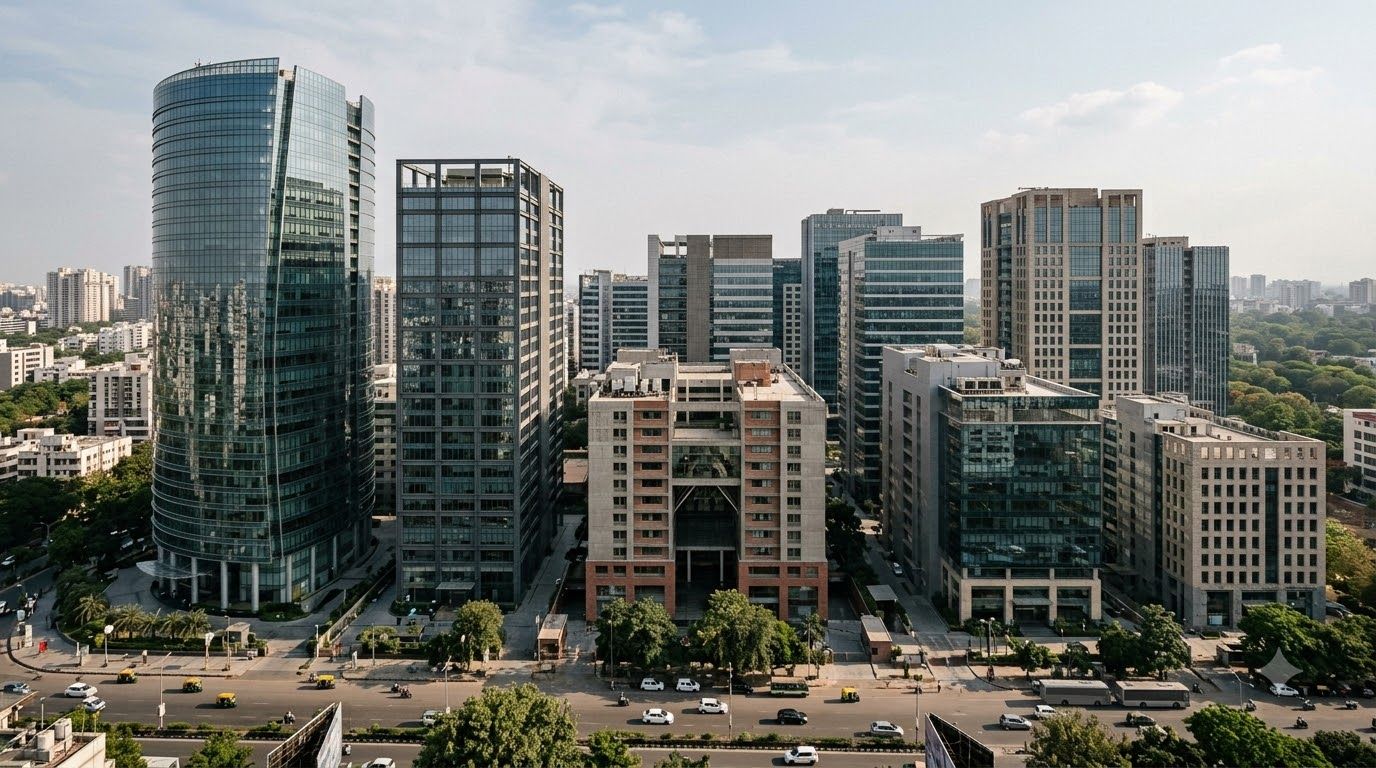
Grade-A commercial properties in India's major business districts are leased to multinational corporations, technology companies, financial institutions, and pharmaceutical firms under long-term lease agreements.
One of the most valuable features of commercial real estate is the rental escalation clause commonly built into lease agreements. Many leases include a 15% rental escalation every three years.
For example, a ₹70 lakh allocation to an SM REIT targeting an 8% yield may generate:
- Year 1: ₹5.6 lakh annual distributions (approximately ₹46,700 per month)
- Year 4: ₹6.44 lakh annually after the first escalation
- Year 7: ₹7.4 lakh annually after the second escalation
- Year 15: More than ₹9.8 lakh annually
Over a long retirement horizon, this income growth helps preserve purchasing power and offset inflation.
Small and Medium Real Estate Investment Trusts (SM REITs) were introduced under SEBI's regulatory framework in 2024 to provide investors access to institutional-grade commercial real estate.
hBits SM REITs provide access to Grade-A commercial properties with detailed disclosure of assets, tenants, and lease structures before investment decisions are made.
Under SEBI regulations, SM REITs are required to distribute 90% of their net distributable cash flows to investors, creating a structured and transparent income mechanism.
Why Residential Real Estate Often Falls Short in Retirement Planning
Residential property remains a popular retirement asset in India, but it presents several challenges:
- Low rental yields, often between 1.5% and 3% after expenses.
- Ongoing tenant and maintenance management responsibilities.
- Limited liquidity during emergencies.
- Concentration risk due to dependence on a single property and tenant.
Commercial real estate through SM REITs addresses many of these limitations by offering professional management, potential diversification, and income-oriented structures.
Layer 3: Equity Growth – The Long-Term Compounder
A retirement portfolio without an equity allocation may struggle to maintain purchasing power over multiple decades.
The role of equities is not to generate immediate retirement income. Instead, equities help fund future healthcare costs, inflation-adjusted expenses, and long-term wealth preservation.
Balanced Advantage Funds and large-cap index funds can provide growth while supporting systematic withdrawal plans for retirees.
Over time, investors may gradually reduce equity exposure as they age and shift toward more conservative allocations.
Sample Structure for a ₹2 Crore Retirement Corpus
- ₹60 lakh in SCSS – Approximately ₹4.92 lakh annual income
- ₹15 lakh in PMVVY – Approximately ₹1.11 lakh annual income
- ₹70 lakh in SM REITs – Approximately ₹5.6–6.3 lakh annual distributions
- ₹35 lakh in Balanced Advantage Fund – Systematic withdrawal income
- ₹20 lakh in Liquid Funds – Emergency and healthcare reserve
This structure may generate approximately ₹14–15 lakh annual income initially, with the potential for income growth over time through commercial real estate escalations and equity compounding.
Conclusion
The best retirement plan in India is not built around a single investment product. It is created through a combination of safety, income generation, and growth.
Government-backed instruments provide stability. Commercial real estate through SM REITs can help address inflation and generate regular income. Equities contribute to long-term growth and purchasing power preservation.
Together, these three layers create a retirement portfolio designed to deliver income today while supporting financial security for decades to come.