
























































































For income-focused investors, dividend-paying stocks have long offered an appealing model: buy a business, hold it, collect a share of its profits every year without selling a single share. But the search for India's highest dividend-paying stocks is more complicated than sorting a screener by yield. High yield can mean a genuinely cash-generative business returning capital to shareholders, or it can mean a stock whose price has collapsed, inflating the yield figure artificially.
In this guide, we break down which sectors in India have delivered the highest and most sustainable dividend yields, what the data tells income investors, and why a growing number of HNIs are supplementing their dividend portfolios with commercial real estate income through SM REITs, where the yield is contractual, inflation-protected, and backed by physical assets rather than corporate earnings cycles.
What Makes a Dividend Stock Genuinely High-Yield Not a Trap
Dividend yield = Annual Dividend Per Share ÷ Current Market Price × 100. The yield rises either when dividends go up (positive signal) or when the stock price falls (potentially a warning). A company paying ₹10/share on a ₹200 stock (5% yield) looks more attractive at 9% yield once the stock falls to ₹111 but the investor holding from ₹200 has lost 44% in capital. That is the yield trap.
Genuine high-quality yield requires:
- Payout ratio 40–75%: sustainable. Above 90% for extended periods signals the dividend will eventually be cut.
- 5–10 year uninterrupted payment history: proves durability through economic cycles including demonetisation, IL&FS, COVID-19.
- Free cash flow coverage: dividends should be covered 1.5x or more by FCF not just accounting profit.
- Dividend per share growth: ideally 5–10% annually, keeping pace with or exceeding inflation.
- Low debt: high-debt companies cut dividends first when cash gets tight.
Sectors With India's Highest Dividend Yields
PSU Energy and Mining: Coal India, ONGC, NMDC, REC Limited, Power Finance Corporation. These companies are subject to DIPAM policy mandating minimum dividend payments. Yields consistently 5–10% depending on commodity cycles. Risk: earnings and dividends move with commodity prices and government direction consistent but structurally unable to grow faster than the commodity cycle allows.
FMCG and Consumer Staples: ITC, HUL, Colgate-Palmolive India, Marico, Britannia. Strong, cycle-resistant cash flows with payout ratios above 60%. ITC grew its DPS from ₹4.5 in 2014 to over ₹7 by 2024. Current yields of 2–4% look modest but yield on cost for patient holders is significantly higher. These compound quietly.
IT Services: Infosys, TCS, Wipro have maintained payout ratios above 80% for a decade alongside buybacks. Current yields 2–3%, but earnings growth alongside creates a total return case.
Utilities: Power Grid, NTPC regulated tariff income, predictable 3–5% yields, very low volatility. The equity equivalent of commercial real estate income: contractual, recurring, not market-cycle-driven.
The Tax Drag Problem for High-Earners
Since Budget 2020, dividends are taxable at the investor's income tax slab rate, with 10% TDS on dividends above ₹5,000 per company per year. For a 30% bracket investor: a 7% gross yield becomes approximately 4.9% after tax. In real terms at 5–6% inflation, that is approximately zero real return.
This is one reason income-focused HNIs with larger corpuses are looking beyond equity dividends. The after-tax yield simply fails to generate real income growth.
Why Commercial Real Estate Income Is Structurally Different
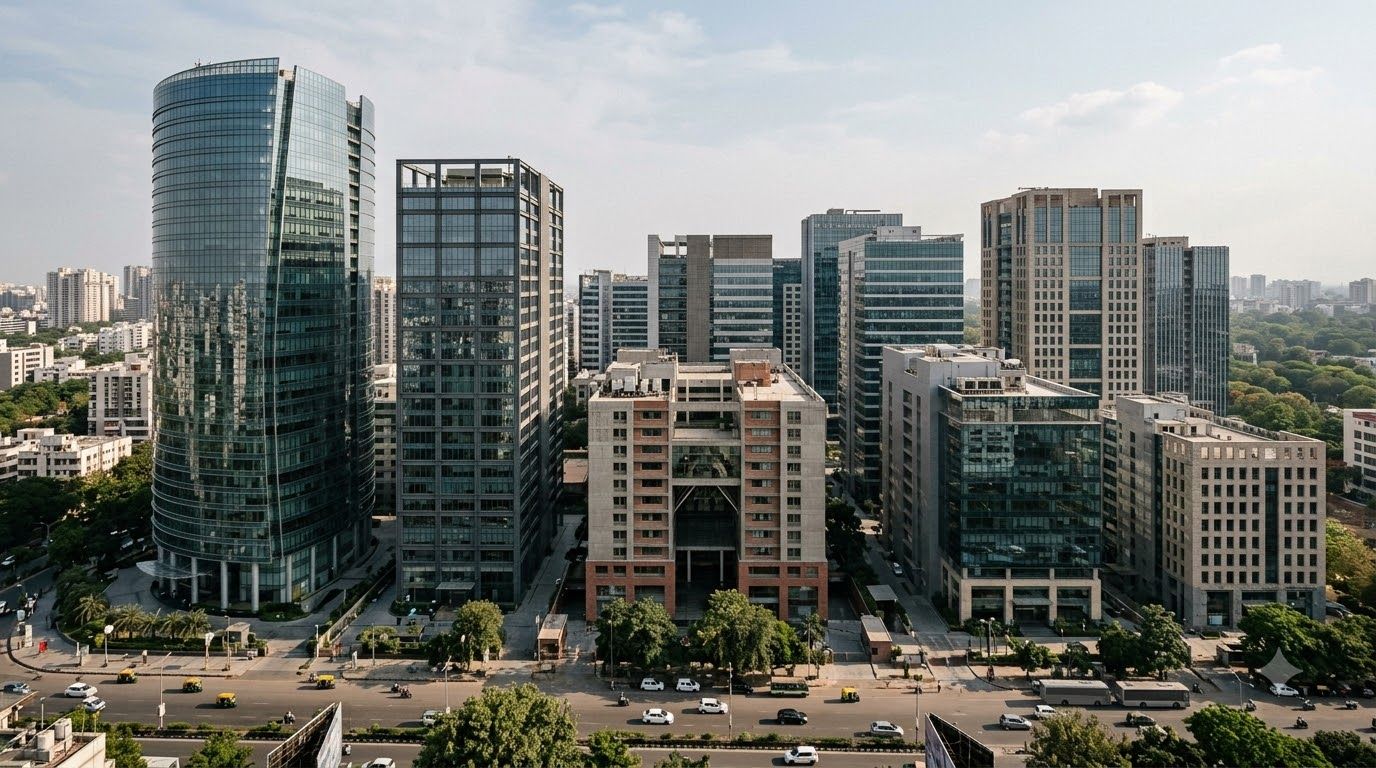
India's Grade-A commercial real estate pre-leased offices in Bengaluru, Mumbai, Pune, Hyderabad occupied by MNCs and large-cap corporates on 3–9 year leases generates rental income with characteristics that equity dividends structurally cannot replicate:
- Contractual: backed by legally binding lease agreements, not board discretionary decisions
- Escalating: standard Indian commercial leases include 15% rent escalation every 3 years written into the contract, not dependent on earnings
- Real-asset backed: income derives from physical property, not financial market sentiment
- Lower equity correlation: commercial real estate income does not move with Nifty cycles
For decades this income was accessible only to investors with ₹5–50 crore for direct property ownership. SM REITs changed this.
hBits (SEBI Reg. No. IN/SM-REIT/25-26/0005) is India's first SEBI-registered SM REIT. Its schemes invest in specific, pre-leased Grade-A commercial properties investors can see the asset, the tenant, the lease terms, and the projected income before committing capital. Under SEBI's SM REIT Regulations, 90% of net distributable cash flows must be distributed to investors quarterly.
Explore how hBits SM REIT generates investor income at hbits.co/sm-reits.
Dividend Stocks vs SM REIT Rental Income: A Direct Comparison
Quality FMCG dividend yield: 2–4% growing at approximately 6–8% per year through DPS growth equity appreciation alongside.
PSU dividend yield: 5–9% variable, commodity and government policy linked consistent but not reliably growing.
SM REIT target rental yield: 8–9% from contractual commercial leases, growing 15% every 3 years through lease escalation regardless of equity market conditions.
Tax: equity dividends taxable at full slab rate. SM REIT: income component at slab rate; capital gains on unit sale may qualify for LTCG treatment depending on holding period.
Asset correlation: dividend stocks move with equity markets. SM REIT distributions move with commercial real estate lease cycles meaningfully different risk profile for portfolio construction.
This comparison is not an argument against dividend stocks. A quality dividend portfolio remains an excellent long-term equity strategy. But for income investors who want cash flow less correlated to equity markets, growing on a contractual schedule, and backed by tangible real assets SM REITs provide a genuinely different income source.
Building a Combined Income Portfolio
The most resilient income portfolios do not rely on a single income source:
- Core equity income: ₹30–50 lakh in high-quality dividend stocks (PSU, FMCG, IT) 4–6% gross yield plus equity appreciation
- Real asset income: ₹20–50 lakh in SM REIT 8–9% target rental yield, contractual escalation, real-asset backing
- Guaranteed income: ₹15–20 lakh in SCSS or PMVVY government-backed safety for essential expense coverage
Three income sources. Three different risk profiles. Three different inflation sensitivities. Together they create a portfolio where no single event equity market crash, interest rate movement, or commodity cycle disrupts all income simultaneously.